‘Transformative’ weight loss market driving threefold growth in private dispensing
Arthur Walsh,
18 May 2026 1 Min
1 Min

Arthur Walsh,
18 May 20261 Min
Arthur Walsh,
18 May 20261 Min


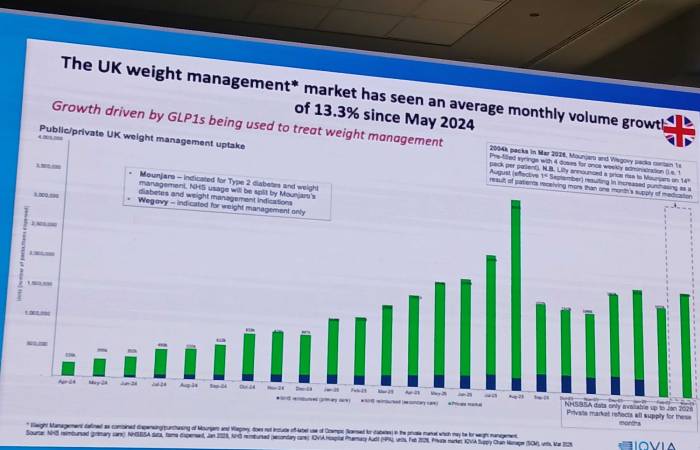
The UK market for weight management medicines has risen by an average of 13.3 per cent each month since May 2024 in terms of volume, an industry analyst has said.
Presenting at Sigma Pharmaceuticals’ Midlands conference in Leicester yesterday (May 17), Chris Pilsbury of clinical trials and market research company Iqvia said Mounjaro is now the most commonly dispensed branded medicine in UK community pharmacies, with 16.3 million units dispensed in the year to March 2026.
He said the rise in GLP-1 dispensing is a key driver in the dramatic growth in private dispensing as a whole, with four per cent of all medicines accessed privately in the year to January 2026 – up from 1.4 per cent in the year to January 2024, a rise of almost threefold.
Analysing the reasons for this, Mr Pilsbury said: “Number one is this idea of patients taking a much more outlook on their healthcare, and then there are the challenges we’re seeing in the NHS [with regard to access]”.
“But also, [there are] the transformative anti-obesity medicines, which are pushing more patients to the private sector due to the limitations of the NHS.”
He said that since September 2025 when the cost of Mounjaro for UK patients rose by up to 170 per cent, there has been a “real drop” of around two million patients.
“We have seen that really reduce – but that is going to change,” he said, noting the success of the Wegovy pill since its launch in the United States this January.
“We’ve seen a huge uptake in the oral medication, and of course that is coming to the UK at the end of the year.
“We expect this to see this grow the market significantly… because it is an oral medication, we’re expecting to see more patient uptake.”
There are 193 obesity medicines currently in development globally, he added.
Mr Pilsbury advised contractors offering a weight loss service to also consider promoting ‘wraparound’ products to help patients cope with the side effects of GLP-1 medicines.
He said: “Organisations are capitalising on the fact there is the opportunity to provide patients with muscle loss and protein [nutritional supplements]... [there are] lots of opportunities to provide patients with access to medications to support those things.”
He cited the recently announced weight loss service partnership between online pharmacy Phlo and wellness chain Holland & Barrett as an example.
Mr Pilsbury said that in addition to weight loss drugs, other growth areas in private dispensing include travel vaccinations – up 27.6 per cent in 2025 compared to the previous year – and ADHD medicines, which have seen a compound annual growth rate of 12.5 per cent over the past decade.
He advised independents to “make sure that you support that growth, rather than it being taken by chains and digital pharmacies”.
Commenting on the wider prescriptions market, Mr Pilsbury said just under three-fifths (59.6 per cent) of generics dispensed in the UK in March 2026 had a Drug Tariff price at or below £1, with £38 per cent priced below 75p.In March 2022, the figure was 20.7 per cent.
He spoke of a “race to the bottom” that is creating “real margin pressures right across the sector”.
He asked: “When are we going to get into the situation where wholesalers are gonna stop delivering medicines because they're not making the margin?
“When are we going to get to the situation where generic manufacturers are actually not launching into the UK because of these margin pressures?
“There’s a real sustainability gap.”