Assessment
Assessment
Rather than asking closed questions, it is often more helpful to explore how symptoms affect daily life.
For example, asking how often sanitary protection needs to be changed or whether pain interferes with work or normal activities can provide more meaningful insight than simply asking whether periods are heavy or painful.
Asking questions about how long periods last, whether there is pain outside menstruation and whether there are associated symptoms such as pain during sex or bowel discomfort can help build a clearer clinical picture.
It is also important to consider the duration and progression of symptoms. Symptoms that are worsening over time or that have changed significantly from the usual pattern should raise concern.
Repeated presentations for analgesics or ongoing self-management may indicate unmet clinical need.
Menstrual bleeding
Heavy menstrual bleeding may be indicated if a woman reports needing to change sanitary protection every one to two hours, is passing large clots, bleeding for longer than seven days or experiencing bleeding that interferes with normal activities such as work or sleep.
These features should prompt consideration of medical assessment, particularly where symptoms are persistent or associated with signs of anaemia.
Associated symptoms
These can provide important additional clues. Pain during sexual intercourse, bowel or bladder symptoms linked to the menstrual cycle, and persistent pelvic pressure or abdominal swelling all suggest the possibility of underlying pathology.
Taken together, these features help to move the consultation beyond symptom description towards clinical reasoning, supporting appropriate decision-making about referral.
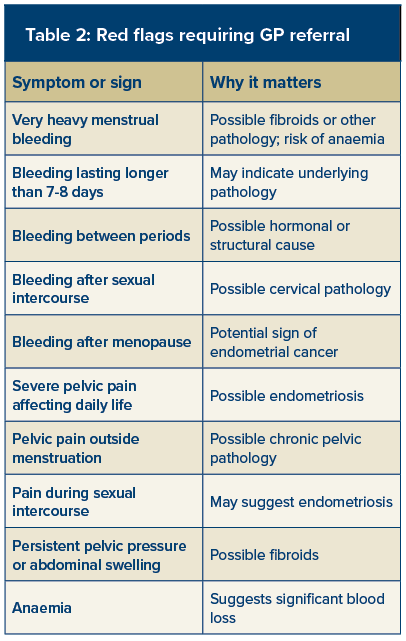
Certain features should prompt referral. See Table 2 for red flag signs and symptoms.